
Why Equity is Important in Project and Policy Planning

Inclusive Needs and Equity Assessment for the planned Jakarta Low Emissions Zone

Equity and related concepts like inclusiveness are often given more serious consideration during the implementation of a project or policy. But this is typically too late, because when equity and inclusivity are not built into planning from the start, it creates a risk that the program or policy will mostly benefit certain parties, while overlooking the needs of others—especially vulnerable groups.
Another difficulty is that concepts like equity and inclusiveness are often felt to be too abstract. Including an equity assessment as part of project planning not only helps achieve better equity-related outcomes, it is also an opportunity to help stakeholders better understand these concepts as well as how they can better integrate these concerns into their work more generally.
Empatika took on this role for the planned Jakarta Low Emissions Zone (KRE Terpadu) as part of a larger project led by Breathe Cities and C40.
The impacts of Jakarta’s persistently high air pollution levels already fall disproportionately on vulnerable populations, imposing significant health, social, and economic costs. Meanwhile, previous Low Emission Zone (LEZ) initiatives have focused largely on transport emissions, an approach that overlooks broader pollution sources and tends to generate uneven social and livelihood impacts.
Empatika’s role for this project started with a needs assessment and stakeholder engagement to help identify risks, opportunities, and priority groups.
This process examined key structural and institutional challenges related to equity and inclusivity, including those identified from previous LEZ pilots. Through interviews with local NGOs and other stakeholders, we mapped vulnerable groups with heightened exposure to air pollution and strong reliance on daily mobility and informal livelihoods and identified gaps in how these groups have been recognized, engaged, and supported in KRE-T planning so far.
Following this, an equity assessment analyzed how the planned Jakarta LEZ would intersect with community members’ everyday mobility, livelihoods, and health, highlighting key equity risks and how they can be mitigated. The process included participatory focus group discussions with community members in two areas of Jakarta.
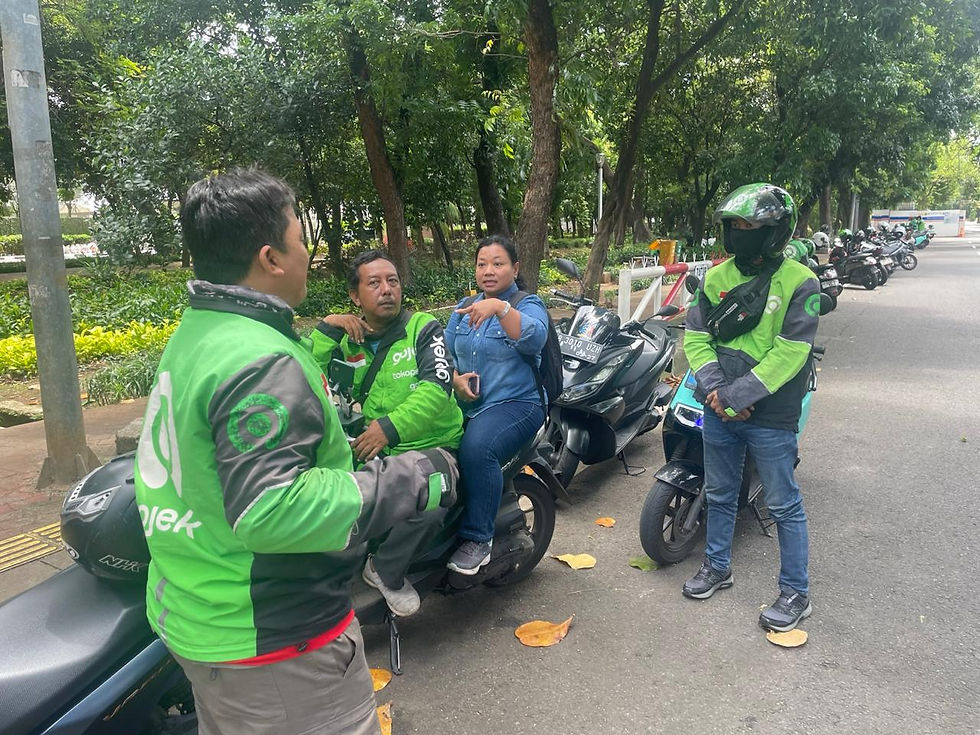
Based on the priority groups identified through the needs assessment, we engaged with a range of community members for the equity assessment, focusing in particular on more vulnerable groups such as informal workers, mothers with small children, and the elderly. Participant recruitment was done through scoping visits and coordination with community leaders to ensure relevance, trust, and ethical engagement.
Focus groups using inclusive, informal, and interactive approaches
The participatory focus groups with community members were designed to promote interaction and comfort, using safe and comfortable spaces and including a variety of interactive exercises such as mobility mapping; scenarios where participants imagined what a LEZ might look like in their area; word and image associations; and priority ranking of potential risks.
Here are some of the key insights gained from the process:
Vulnerable groups face a number of potentially significant overlapping risks
Across the locations, KRE Terpadu measures—such as vehicle restrictions, rerouting, and spatial reconfiguration—impose overlapping economic, health, and mobility risks on vulnerable groups. Potential impacts include income loss, higher transport and operational costs, reduced access to customers or workplaces, and increased exposure to pollution, noise, and safety hazards.
Primary challenges for improving equity related to: 1) communication and public trust, and 2) livelihoods. Two key findings surrounding these topics were the long-term and “invisible” nature of air pollution and policy implementation that has not sufficiently prioritized inclusion.
1) Communication and public trust
“If the sky looks blue, the air must be clean.” - Mother, Dukuh Atas
Community members in the study locations understand air pollution through direct sensory experiences, recognizing everyday traffic in narrow streets primarily as a safety concern rather than an air-quality issue.
2) Livelihood risks
Small changes can create big impacts on community livelihoods, and this was the most pressing concern for informal workers, who interpret the KRE Terpadu plan as a potential economic risk rather than a health intervention.
“If we drive longer distances, we run out of fuel, lose orders, and our income drops. That is a risk for our family.” - Motorbike Taxi Driver, Dukuh Atas
For instance, motorbike taxi and logistic drivers will likely incur longer routes with increased fuel costs, directly impacting daily earnings.
Meanwhile, while some street vendors near pedestrianized areas may benefit from higher foot traffic, other street vendors may be forced onto side streets, disrupting their visibility and income.
What do community members want to see
Community members emphasized the need for simple, face-to-face communication about KRE Terpadu—preferring clear messages and visuals using plain language. They also favor predictable rules and a phased approach to implementation to protect livelihoods, such as socialization in communities followed by an initial trial period to test effectiveness and help build new habits before moving forward with more direct enforcement of any restrictions and changes.
Challenges for equitable and inclusive planning
Challenges with greater prioritization of inclusion identified through stakeholder interviews included poor coordination due to unclear roles and responsibilities across different agencies. For example, in areas where access has already been restricted undefined responsibilities for area management, regulatory enforcement, and inter-agency coordination have constrained pedestrian and public transport access, leading to income losses for street vendors.
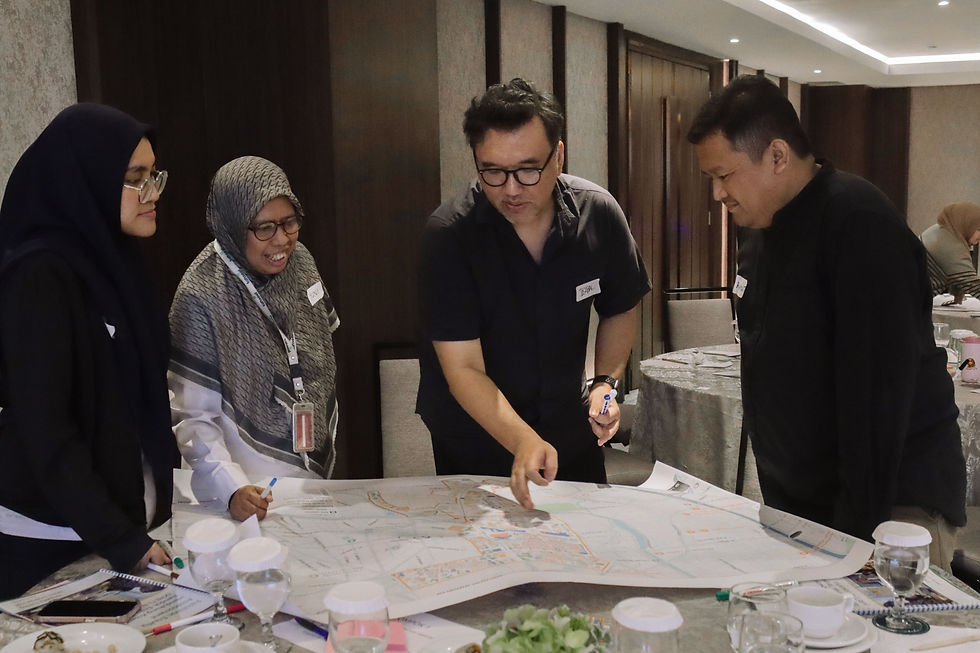
Equity assessment training for local stakeholders
Towards the end of the project, we held an equity assessment training with government stakeholders’ to improve their understanding and capacity for integrating equity considerations into their work and conducting their own assessments. The training discussed how bias and power dynamics shape community engagement and what practical methods can be used to address these barriers. It emphasized skills such as active listening, inclusive facilitation, and choosing appropriate engagement formats when working with communities using interactive exercises like image association, mobility mapping and scenario discussions.
Other Takeaways
Project stakeholders acknowledged the need to improve their understanding of community needs and the role of equity in project planning. They also noted a distinct opportunity to strengthen inclusivity through collaboration between government and civil society organizations.
Our team noted that large projects such as a LEZ should consider establishing a forum that brings together stakeholders and community representatives as part of achieving a more comprehensive learning process throughout project planning and implementation.
Why inclusivity matters
Fairness is associated with implementation that feels respectful and predictable.
Minimal engagement and collaboration with local communities is an unfortunate reality for many large projects, which threatens fairness and inclusivity right from the start. When communities are directly involved and equity is part of the planning process from the start, projects will be much more likely to bring positive impacts that serve the needs of the wider community.
As the Jakarta LEZ planning process continues past this initial feasibility phase, we look forward to seeing how these equity-related findings are carried forward.


Comments