
Empowering Caregivers of Children with Disabilities in Indonesia
Caregivers of children with disabilities (CwD) in Indonesia face three difficult realities:

Limited understanding about CwD, including about parents own role in supporting child development.

Stigma about CwD.

Very limited support ecosystems in most parts of the country.
Background
Empatika conducted research on the experiences of caregivers of children with disabilities (CwD) in 2023-2024 in five regions in Indonesia (Jakarta, Cianjur, Solo, Surabaya, and Bali) in collaboration with Total Mind Learning and with support from the World Bank. This study revealed a stark picture for CwD support in Indonesia including :

Lack of Clear Information
Parents struggle to find clear information about their children’s conditions and support.
Emotional Burdens
Stress, sadness, confusion, and judgment from others are constant companions for these parents.
The "Cure" Mentality
Many parents view their child's condition as something to be "cured" by professionals, rather than a journey requiring their active involvement.
We found parents' journeys consisted of five general pathways, three of which result in caregivers either losing motivation to provide support for their children, or only providing limited support.
Click on the graphic to view it in full size!
Disconnected Support
While many parents engage with their children at home, they often lack understanding of developmental stages, how therapy truly supports growth, and crucially, there’s a significant disconnect between therapy at home, therapy centers, and school.
The Unseen Key
We realized that parents themselves are the most critical factor in their child's development. Their acceptance, understanding of child development, and willingness to collaborate with professionals are paramount.

While these findings certainly highlighted issues with the CwD support system in Indonesia, perhaps even more critically they illuminated two critical and more elemental areas where parents need empowerment and support :
-
developing a positive mindset, and
-
gaining a deeper understanding of child development.


Our Solution
Training to Empower CwD Caregivers
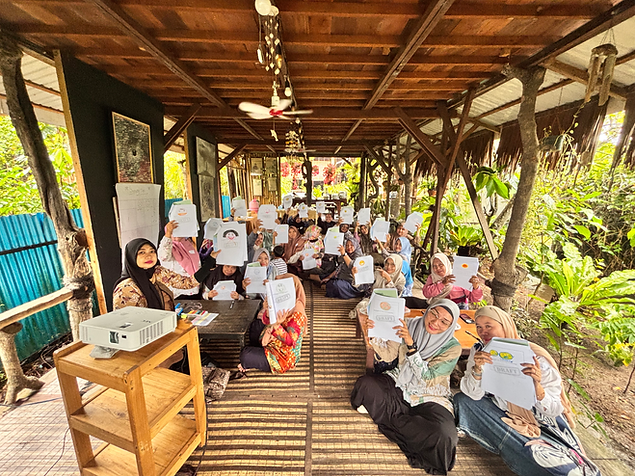
To begin to help provide this support for parents and caregivers, we developed a caregivers guideline and a multi-day training program for parents and caregivers. With support from the World Bank, this training program was rolled out in 13 cities and regencies across Indonesia in 2025, including more than 1,000 participants!
The caregivers guideline that formed the base and companion document of the training was developed in collaboration with Total Mind Learning. Our goal was to provide practical steps and motivation to support caregivers’ journey alongside their child, emphasizing to parents that :

You are the key to your child’s positive development!
Our "Four-Finger Approach" provides a simple, memorable framework for parents to support their children effectively:

Becoming Empowered and Resilient Parents
Fostering a supportive mindset is the foundational step.

Understanding and Utilizing Assistive Technology
Learning strategies to enhance communication, manage behavior, and promote learning, often with readily available materials.

Supporting Optimal Child Development
Understanding your child and their developmental processes and stages is crucial.

Parent Collaboration with Professionals
Actively engaging and collaborating with experts to create a unified support system.
The caregiver guidelines and training approach aimed to promote a willingness to continue learning, be consistent, celebrate small progress and stay positive, try different approaches, and seek out supportive communities.
How did the training work

The training program was rolled out from February to June, 2025, starting with recruitment and training of local facilitators.
To ensure the training is customized to local contexts and parents’ needs, Empatika recruited local facilitators, consisting of parents, teachers, and therapists, in each location.
These facilitators were trained by our team during extensive 2-day offline training sessions. In addition to going through the caregiver guideline and training materials, this facilitator training aimed to instill a shared empathy around the variety of experiences and challenges that caregivers, educators, and therapists face in supporting CwD, fostering a supportive and empowering environment.
In total, 102 local facilitators were trained, eight facilitators per location.* Facilitators paired up so that each location would have four training groups. Each group then worked to recruit 20 to 25 parents and caregivers around their area.


Locations and participants
The training was conducted in 13 locations across Indonesia including Aceh, Bali, Central Java, East Java, Jakarta, South Kalimantan, South Sulawesi, West Java, and Yogyakarta, involving over 1,000 parents and caregivers and over 100 local facilitators.
Training sessions
Each training ran over two days, with two modules, or fingers, of the four main training topics covered each day.
Monitoring process
As part of the caregiver training, and included in the caregiver guidelines, parents/caregivers were given a number of tasks to try over a period of around four weeks following their training.
Local facilitators continued to support caregivers throughout this process, and made notes about the overall progress, response, and feedback from their groups.
Our team conducted reflection calls with facilitators from a selection of the training locations, as well as interviews with more than 25 caregivers who participated in the training.

Development of orangtuaberdaya.com
As a companion to the caregiver guidelines developed for this training and a living knowledge hub, our team also developed a dedicated website at www.orangtuaberdaya.com, where caregivers can find a range of guidance and resources to support CwD.

Report
We also prepared a report in English and Bahasa Indonesia which summarizes the training process and the immediate impacts caregivers and facilitators gained from the training to help advocate for similar programs, including the potential scale-up of this caregiver training, as well as improvements to the support ecosystem in Indonesia.
Feedback and Impacts
I often open social media, and try to search for how to handle children like mine, but [it is still difficult]...This is [where the training was] very helpful. I didn't understand what gross motor skills are, what the learning tree is, that there are so many sensory systems to learn about. You know, if we go to a psychologist [before the training], we don't really understand, only the psychologist understands the explanation. But after this [training], now when I have some free time, I can read [the caregiver guidelines] and understand.

- Caregiver, East Jakarta
We collected feedback from the training through a variety of methods, including feedback surveys, reflection calls with facilitators in six locations, monitoring notes from caregivers’ and facilitators, and online interviews with 25 training participants across all of the training locations.
The feedback has been overwhelmingly positive from both participants and facilitators. Many facilitators commented that participants were eager to continue past the end of the training schedule, even when the training was held in the afternoon or evening. A facilitator in Malang commented that, “the testimonials from participants were amazing. For example, the interactive techniques and methods: both facilitators and participants are not just listening, they are invited to be interactive and practice. 4 hours together is hardly felt.”
72% of caregivers described the impacts for themselves following the training being very significant, while the remaining 28% of caregivers described some impact. Related to impacts for their children, 48% of caregivers interviewed described very significant changes for their children as well.
I treat the guidelines like my 'holy book', because for me, it's ideal… Before joining this program, I was already on the front lines [at school], but what I realized is that while I was already doing many of these things, I was doing them in a disorganized, scattered way. Through this training, I learned that there is actually a structure to it. That was something new for me… It helped me identify the parents' competencies as well, so that I, as a facilitator [and teacher], can better understand where they are and how I can be a helpful and effective partner to them.
- Facilitator, Bali
The First Finger's Transformative Power
The most significant and immediate impact was seen in the first module: "Becoming Empowered and Resilient Parents." This module, mentioned as the most helpful by 76% of caregivers, transformed their emotional landscape.
Reduced Stress and Increased Confidence
72% of caregivers and 67% of facilitator groups reported reduced stress. Parents learned self-management techniques, like the 4-4-4 breathing exercise, and discovered that their calmness directly impacts their child's demeanor. As a caregiver in Aceh shared, “Because parents are calmer, their children are calmer and easier to handle after participating in the training.”
Positive Outlook and Acceptance
52% of caregivers explicitly mentioned gaining a more positive outlook, spirit, confidence, and acceptance of their child's condition. In Aceh, a caregiver shared a common sentiment that, “I learned that first, [I need to] make peace with myself, accept [my situation], and calm myself.”
Breaking Isolation
Being with and hearing from other parents was a powerful antidote to loneliness and stigma. Caregivers realized they weren't alone, fostering a sense of community and shared strength. A caregiver in Bali powerfully stated, “seeing other parents, I realized we are strong, there's nothing to be afraid of, our children are unique.”
Enhanced Understanding and Engagement Across All Four Fingers
While the first finger was noted as the most impactful module overall, facilitators and parents described significant impacts and changes across all four fingers/modules. In particular, these included:
Child Development Insights
Parents gained a better understanding of child development stages and how to support skill acquisition. The "learning tree" was particularly impactful in this regard.
Practical and Simple Assistive Technology
A major revelation for many caregivers was that AT doesn't have to be expensive or complex. Parents learned to create effective AT from everyday items and utilize their child's surroundings for supporting their development. This has already empowered some parents to expand the time spent with their child, develop daily routines, and reduce reliance on multiple therapy centers.

Active and Consistent Parenting
Many caregivers learned about the importance of consistency and being involved and engaged with their child. For example, participants shared about creating daily routines, engaging in more interactive play, and reducing gadget use.
Improved Communication and Collaboration
The training fostered better communication between parents and teachers, creating a more continuous flow of information and support. Parents also gained confidence in seeking and collaborating with professionals, with some even making their first visits to therapists after the training.
Positive Discipline
Parents learned the importance of clear, consistent, and positive discipline, moving away from harsh punishments and towards open communication and understanding. This shift led to children becoming more responsive and calmer.
Tangible Improvements for Children
While caregivers themselves saw the most immediate impacts, many caregivers also reported very significant changes for their children. 83% of facilitator groups felt that impacts for participants’ children were significant. Some of these impacts included:
Increased Independence and Confidence
Many parents shared that their children had already become more independent and confident, particularly with the use of consistent routines.
Improved Learning and Behavior
Many parents shared positive impacts such as increased interest in learning, improved focus, better adherence to schedules, reduced tantrums, and in some cases, improved communication.
Stronger Parent-Child Bonds
As parents became calmer, more accepting, and more engaged, the relationship with their child also improved, leading to more positive interactions and a closer emotional connection.

A Ripple Effect: Sharing and Community Building
The enthusiasm wasn't confined to the training sessions. Many participants and facilitators eagerly shared their newfound knowledge and confidence with family, friends, and even strangers and local government officials.

Next steps
Our hope is that this training program can be rolled out to more locations in Indonesia as part of continuing to help put caregivers, and their children, in a better position to thrive, as well as push for improved support ecosystems.
In addition to potential integration and support directly through the Indonesian Ministry of Primary and Secondary Education, we continue to pursue other sources of funding and support to be able to continue this and similar work to support CwD and caregivers in Indonesia.

Please contact us for more information!